Industry Horizon 2025–2030 Key Technological Development Trends in the RGB Bluetooth Speaker Sector
The global portable audio market is undergoing a rapid technological convergence where digital signal processing, micro-optoelectronics, and energy-dense battery chemistry intersect. For B2B procurement managers and consumer electronics importers, understanding these macro tech trends is essential to avoid purchasing obsolete inventory and to build high-margin catalog strategies.
1. Real-Time Hardware-Level FFT Sound-to-Light Processing vs. Software Presets
Early-generation lighted speakers relied on pre-programmed, static lighting cycles or rudimentary envelope-detector circuits that flashed randomly regardless of audio tempo or frequency spectrum. Modern professional-grade RGB Bluetooth Speakers incorporate dedicated hardware Digital Signal Processors (DSPs) running Fast Fourier Transform (FFT) frequency partitioning algorithms.
This architectural shift allows the micro-controller unit (MCU) to divide incoming audio signals into distinct frequency registers in real time: bass frequencies (20Hz–250Hz) trigger low-frequency pulse animations, midrange frequencies (250Hz–4kHz) modulate color hue transitions, and treble frequencies (4kHz–20kHz) drive dynamic luminance flashes. This hardware-level separation operates with under 0.05 milliseconds of latency, creating a seamless visual representation of music rhythm.
2. Advanced Thermal and Electrical Isolation in Compact Enclosures
As consumer demand shifts toward smaller form factors with higher acoustic output (watts RMS), managing internal heat generation and electromagnetic interference (EMI) becomes paramount. High-power RGB LEDs generate localized thermal buildup on internal printed circuit boards (PCBs). If unmanaged, this heat transfers directly to lithium-ion battery cells, accelerating capacity degradation and raising safety risks.
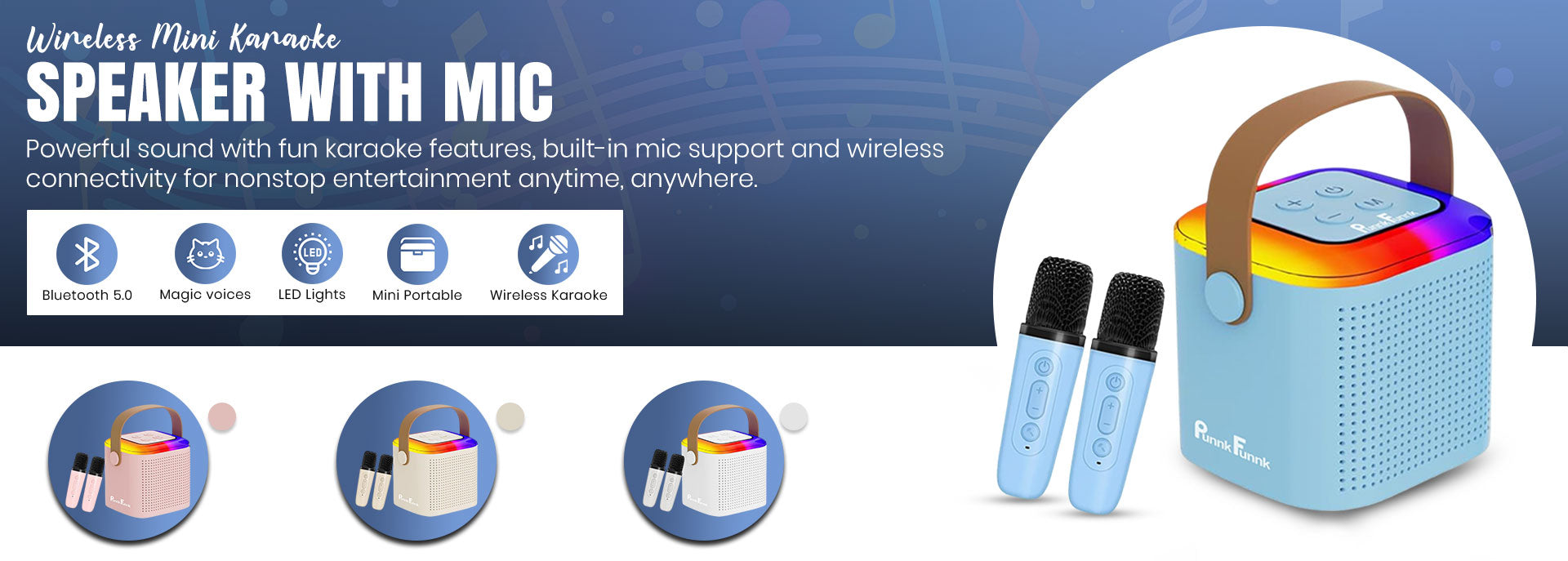
PunnkFunnk solves this through dual-PCB architecture, separating high-temperature LED driver matrices from thermal-sensitive battery management systems (BMS) and acoustic amplification circuits. Furthermore, custom aluminum heat sinks and thermal conductive pads dissipate excess heat away from the internal cavity, ensuring stable continuous output even under prolonged maximum-volume usage.
3. Bluetooth 5.3, LE Audio, and Auracast Broadcast Expansion
The transition from legacy Bluetooth 4.2 / 5.0 to Bluetooth 5.3 and Low Energy (LE) Audio fundamentally alters product capabilities. Next-generation RGB Bluetooth speakers leverage LC3 codec support, reducing bitrates by over 50% while improving perceived acoustic clarity and lowering transceiver power consumption by 30–40%.
Moreover, the integration of Auracast™ broadcast audio protocols enables a single master Bluetooth source to broadcast synchronized audio to an unlimited number of secondary RGB speakers within a venue. Combined with multi-unit RGB light synchronization algorithms, retail brands can offer multi-room or multi-speaker party setups that lock both sound and light patterns in perfect unison across vast spaces.
4. Eco-Conscious Materials and Modular Circularity
Environmental regulations across the European Union (WEEE, REACH, RoHS 3) and North America are tightening stringently. Future procurement cycles favor manufacturers using post-consumer recycled (PCR) ABS plastics, halogen-free wiring harnesses, and modular battery assembly designs that allow non-destructive recycling at end-of-life. PunnkFunnk actively incorporates non-toxic, flame-retardant PC/ABS resins into all outer speaker shells without compromising drop resistance or IP-rating integrity.


 DSP Sound-To-Light Sync